
Map & Grounds


Columbarium
 Enter. Rest. Reflect.
St. George's Columbarium offers both a sacred resting place and a continuing witness to risen life, linking the departed to the living in the faith of Jesus Christ, who said: “I am resurrection and I am life.”
The word "columbarium" is derived from the Latin word columba, meaning dove, symbol of peace, the Holy Spirit and the risen Christ. St. George's Columbarium offers a series of recessed niches to receive the inurned remains of one or two persons.
The setting
Designed by the nationally recognized architectural firm of Hyndman and Hyndman, the Columbarium links the mission style church of 1969 with the parish hall complex opened in 2001. Spacious arches open onto flowerbeds and lawns that overlook Avenida de la Carlota, inviting the community to enter, rest and reflect upon their lives.
Inviting memorial benches and a labyrinth, based on the medieval design on the stone floor of Chartres Cathedral in France, are located in the Robert Bonhall Plaza. The labyrinth provides a focus and pathway for a meditative walk into its center. The area is reserved (like the church sanctuary) during the week and between Sunday services for quiet, meditation and prayer.
For further information and a tour of our facilities, please contact: [email protected]
Labyrinth
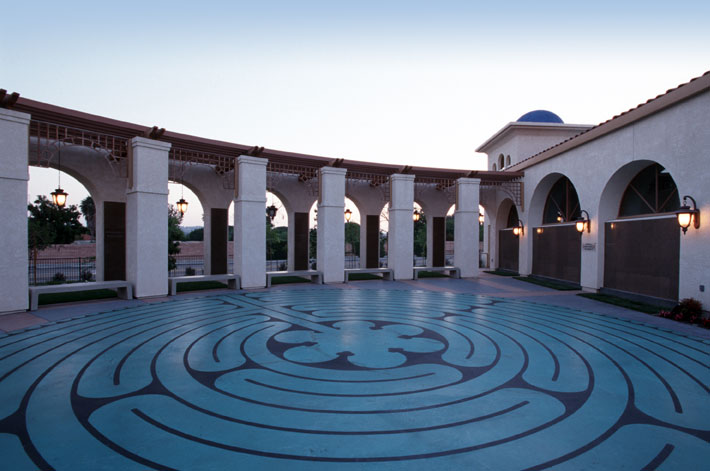
Open 24/7: Pilgrims are invited to enjoy our labyrinth, which reprises the one at the Chartres Cathedral near Paris, built in 1200 AD. Traditionally, labyrinths were a way to become closer to God and served as a substitute for a Holy Land pilgrimage.
Our labyrinth is an 11-circuit design divided into 4 quadrants. The pilgrim wanders through each quadrant several times before reaching the rosette design at the center.
The rosette symbolizes enlightenment, the journey from the outside world to the center of self and then back to the outside world with a deeper understanding of who you are.
There is no right or wrong way to approach this journey.
Church Windows
 Introduction
St. George’s traces its history back to the late 1880s, when the El Toro Land and Water Company donated land for a church at the intersection of El Toro Road and Whisler Drive. The chapel, completed in 1891, was served at first by circuit-riding priests who also traveled to churches in Anaheim, Tustin, Santa Ana and Orange.
 After many years with a small, often struggling congregation, St. George’s Mission grew quickly in the 1960s, with the development of Leisure World and Mission Viejo. In the late 1960s, it became a self-supporting parish under the leadership of its first rector, the Rev. Frederick C. Hammond, and in 1969 dedicated the current church building on Avenida de la Carlota in Laguna Hills.
In recognition of the importance of its relationships with nearby churches and with the worldwide church, 13 of the new structure’s 32 stained-glass windows commemorate neighboring Episcopal churches, while the 16 upper windows commemorate the Anglican Communion, its affiliated national churches and provinces, and the Diocese of Los Angeles.
St. George’s belongs to the Diocese of Los Angeles, which is part of the Episcopal Church of the Unites States, one of the 38 autonomous provinces and churches in the 70-million-member Anglican Communion, located in 164 countries.
Two of the other windows – those located closest to the pulpit – are devoted to St. George himself and to the original St. George’s Mission chapel.
The remaining window is of St. Edward the Confessor, the builder of Westminster Abbey, one of the most beloved churches in the worldwide Anglican Communion.
- Susan and Colin Stewart
For more information on St. George's Church Windows, click here >
For further information and a tour of our facilities, please contact: [email protected]